Library QR Code for Catalogs, Reading Lists & Resources
Create library QR codes for catalogs, reading lists, guides, events, book reviews, digital resources, maps, and support pages. Use them on shelves, posters, handouts, and library cards.
Free QR code generator
Create a QR code online
Generate QR codes for websites, email, phone numbers, vCards, Wi-Fi, plain text, forms, PDF files, and campaign links. Customize colors, add a logo or frame, then download a print-ready PNG or SVG.
Choose QR code type
Website QR code, Email QR code, Phone QR code, vCard QR code, Wi-Fi QR code, Text QR code, SMS, WhatsApp, event, and download links.
Add your content
Enter your website URL, contact details, message, phone number, location, or file destination before generating the QR code.
Customize and download
Adjust QR colors, error correction, logo, frame, size, and margin. Generate QR Code, Download PNG, Download SVG, or Save and track scans.
Library resource access
Help readers move from the shelf to the right digital resource
A library QR code is useful when a shelf, display, handout, poster, or desk sign needs to do more than point people toward a general website. It can open a catalog search, reading list, research guide, event page, book review, digital database, room map, support page, or student resource. That makes it helpful for public libraries, school libraries, university libraries, reading programs, community centers, and librarians who want patrons to find the right resource without asking someone to spell a long URL.
The best use is simple: place the code next to the moment of curiosity. A shelf sign for local history can open a curated research guide. A display of new fiction can open staff picks or reserve links. A workshop flyer can open registration. A study room sign can open booking rules or a map. QR Code Lab helps you make that bridge clear, printable, and easy to update when the destination changes.
QR Code Lab creates QR codes and can help with dynamic links and scan analytics. It does not run your catalog, host protected databases, manage events, collect patron records, or replace your library system. The code should point to the approved catalog, guide, event page, or resource your library already controls.
Schools, classrooms, workbooks, and textbooks
Connect library visitors to the exact resource they need next
Learning accessA library QR code should turn shelves, posters, bookmarks, event flyers, study rooms, exhibits, and checkout materials into direct paths for catalogs, renewals, databases, programs, reading lists, forms, and help.

Open catalog and account actions from the shelf
Use QR codes near shelves, displays, and checkout areas to open catalog records, availability, hold requests, renewals, reading lists, or account help without making patrons search from scratch.

Attach digital resources to physical materials
Place QR codes on handouts, bookmarks, course reserves, exhibit labels, and research guides so visitors can open databases, ebooks, source lists, videos, archives, or librarian notes from the item in front of them.

Support events and programs
Use QR codes on posters, lobby signs, calendars, and room doors to open registration, schedules, speaker details, workshop materials, surveys, or follow-up resources.

Reduce repeated service desk questions
A QR destination can explain printing, Wi-Fi, study room booking, library cards, fines, hours, accessibility, and contact paths while staff still handle complex help.

Keep school and campus resources current
Dynamic QR helps when databases, class guides, due dates, room bookings, program pages, or policy notes change after flyers and bookmarks are printed.

Make help discoverable without crowding signs
Use a short printed CTA and a mobile page for detailed instructions, language options, accessibility notes, contact links, and next steps.

Guide younger readers and parents
Family areas can link to reading challenges, age-level lists, story time schedules, homework help, parent forms, and safe digital resources.

Support exhibits and archives
Exhibit labels can open source notes, audio, translations, image credits, timelines, maps, or related collection materials.
Patrons should land on the resource promised by the sign
The QR code should remove search friction by opening the exact catalog item, database, form, event registration, room booking, or help page connected to the printed context.
Library teams can update the resource without replacing every sign
Dynamic QR is useful when programs, hours, databases, guides, room links, or policy pages change while posters, shelf cards, and bookmarks stay in circulation.
Put the QR beside the library moment
Library placement
Place library QR codes where search friction begins
PlacementLibrary QR placement should sit at the point where a patron would otherwise type a URL, search the catalog, ask staff for a form, or leave a printed sign without taking the next step.
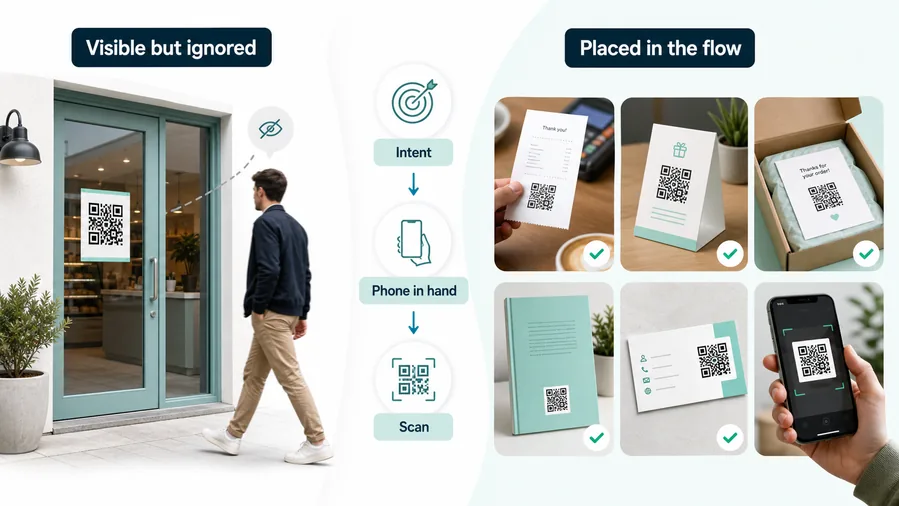
The code points somewhere broad
A generic homepage QR on a library sign does not help much when the patron wants one catalog item, program signup, database, room booking, or support path.
The more specific the printed context, the more specific the destination should be.
The QR opens the resource tied to that spot
Put catalog links near displays, registration links on program posters, room booking links near study spaces, and source notes beside exhibits.
The printed caption should say what the visitor gets: reserve this book, join this event, open this guide, book this room, or ask a librarian.
What would the patron have to search for?
Use the QR to skip catalog lookup, database navigation, form hunting, or typed URLs.
Is the destination specific enough?
A shelf card, event poster, exhibit label, or study room sign should open the matching resource.
Will the resource change later?
Use dynamic QR when events, databases, forms, hours, or guides may move.
Do accessibility notes matter?
Include language, audio, large-print, contact, or staff-help options when relevant.
Shelf display or bookmark
Open catalog records, reading lists, holds, renewals, ebooks, and related recommendations.
Event poster or room door
Send patrons to registration, schedules, speaker materials, maps, or surveys.
Study room or service sign
Link to booking, room rules, printing help, Wi-Fi, accessibility, and staff contact.
Exhibit label or archive card
Open source notes, audio guides, translations, collection records, and related materials.
Poster or event sign
Best where people pause: registration line, booth, waiting area, seat back, schedule board, or exit path. Weak when people only pass at speed.
Business card
Useful after a conversation because the person already knows why they might save a contact, open a portfolio, book a call, or follow up.
Window sign
Good for after-hours menus, booking, pickup instructions, or quick offers. Avoid complex actions when the person is outside and just walking by.
Cover or front label
Use it only when the promise is immediate and clear. Otherwise the better scan moment is often inside the material or after the first interaction.
Library QR codes should replace search with direct access
Use the code where the patron already has context, then send them to the exact resource that context promises.
Library print readiness
Print library QR codes for real shelves, signs, cards, and posters
Print readyLibrary QR codes may live on bookmarks, laminated signs, shelf talkers, room doors, exhibit labels, posters, and handouts. They need enough size, contrast, quiet zone, and plain CTA copy to work in those physical settings.
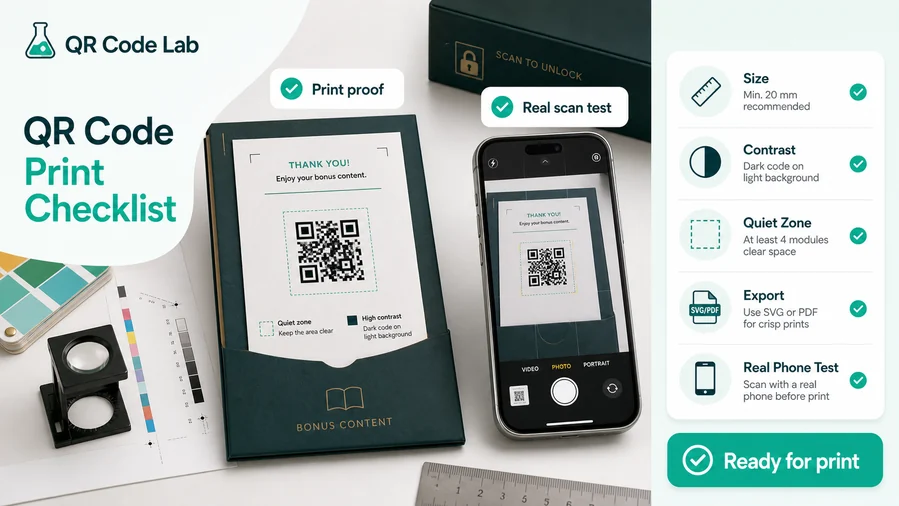
Match size to the way patrons scan
A bookmark QR can be small because it is scanned up close, but a poster, doorway sign, or shelf display needs more size and contrast.
Test the real printed sample in the aisle, lobby, room, or exhibit lighting before distributing materials.
Write the destination promise beside the code
Use concrete captions such as “Reserve this book,” “Register for the workshop,” “Open the database guide,” or “Book this study room.”
Avoid bare QR codes on library print because patrons may not know whether the scan opens a catalog, form, map, policy, or external site.
Use a mobile landing page when one library sign needs several actions
Some library placements need more than one link: catalog, ebook, reading list, help desk, translation, event registration, and accessibility notes.
A compact mobile page keeps the printed sign clean while still giving patrons several clear options.
Bookmark
Link to renewals, holds, reading lists, ebooks, or a specific book page.
Event poster
Open registration, speaker notes, schedule, room map, and follow-up resources.
Study room sign
Send patrons to booking, rules, equipment notes, Wi-Fi, and staff support.
Exhibit label
Connect objects to sources, audio, translations, archives, and related collection items.
Library QR print should be specific and scannable
The physical code, caption, and destination should work together so patrons know why scanning is worth it.
Shelf and display flow
Put the code where patrons are already choosing what to do next
Library QR placement should follow the patron journey. A code at the front desk can help with hours, cards, and general help, but a code inside a specific shelf, display, classroom packet, or event poster can do something more useful: it can answer the question the person already has. Someone looking at travel books may want a reading list. Someone near a 3D printer may want booking rules. Someone reading a children's event poster may want the signup page immediately.
Use clear calls to action such as open the reading list, reserve this book, view the research guide, register for the workshop, find this room, or get digital access. Avoid vague scan me labels when the library has a practical next step to offer. If you use a dynamic QR code, you can update the destination later without reprinting shelf cards or posters. Scan analytics can show which displays, flyers, and resource signs actually move patrons into the digital layer, while private patron activity remains inside the destination systems you already use.