
Address QR Code Generator for Maps, Directions & Venues
Create address QR codes for shops, offices, venues, listings, and visitor guides. Scanners open maps or directions fast, without typing addresses or coordinates by hand on mobile today.
Free QR code generator
Create a QR code online
Generate QR codes for websites, email, phone numbers, vCards, Wi-Fi, plain text, forms, PDF files, and campaign links. Customize colors, add a logo or frame, then download a print-ready PNG or SVG.
Choose QR code type
Website QR code, Email QR code, Phone QR code, vCard QR code, Wi-Fi QR code, Text QR code, SMS, WhatsApp, event, and download links.
Add your content
Enter your website URL, contact details, message, phone number, location, or file destination before generating the QR code.
Customize and download
Adjust QR colors, error correction, logo, frame, size, and margin. Generate QR Code, Download PNG, Download SVG, or Save and track scans.
Location handoff
Use an address QR code when the scan should help someone reach a real place
An address QR code is useful when the scanner needs a location, not a long typed address. It can point people toward a shop, office, venue, event entrance, property, pickup point, classroom, clinic, booth, meeting room, hotel, campus building, or temporary pop-up from a flyer, sign, business card, invitation, real estate board, printed guide, or window notice. The value is simple: remove the spelling, searching, and copy-paste step at the exact moment someone is trying to get there.
The practical choice is whether to encode a plain address, coordinates, or a map URL. A plain address is simple and device-friendly, but different phones may open different map apps and may interpret the location slightly differently. Coordinates are useful when the place has no clear street address or the entrance is away from the official building address. A map URL gives you more control over the exact place listing or pin, especially inside a venue, shared building, market, campus, mall, event site, or property complex.
Before printing, test the scan on phones and confirm the destination opens the correct place. A tiny typo can send people to the wrong side of town, and a vague venue name can be confusing when there are multiple branches or similarly named locations.
Location scan moments
Use address QR codes when the scanner needs to find a real place
Address QRAn address QR should open a location, map, route, pickup point, parking note, venue entrance, office, store, booth, or service area without forcing people to copy an address by hand.
Turn printed addresses into usable directions
Use address QR codes on invitations, business cards, flyers, signs, appointment cards, invoices, delivery notes, and event handouts when people need directions from a phone.
The printed CTA should say directions, map, parking, entrance, or pickup point.
Add the context a map pin alone cannot explain
A useful destination can include suite number, entrance, parking lot, pickup zone, gate, floor, hours, accessibility route, and contact details.
Location friction often comes from missing context, not the address itself.
Use dynamic QR when the route details may change
Parking, entrances, event rooms, pickup points, construction notes, and office details can change after print. Dynamic QR keeps the printed shortcut current.
Good for signs, cards, and long-lived local materials.An address QR should remove the tiny frictions that make people late
People scan because they are trying to get somewhere. The destination should make the location, route, arrival note, and fallback contact clear before they are standing at the wrong door.
Use specific labels: get directions, find entrance, parking map, pickup point, or office location.Maps and routes
Open the correct map pin, walking route, driving route, parking area, entrance, or transit stop.
Arrival context
Show suite, floor, gate, room, hours, accessibility, pickup point, and building notes.
Business and event use
Use for stores, offices, venues, pop-ups, booths, appointments, deliveries, and local service calls.
Editable logistics
Use dynamic QR when location notes, parking, hours, rooms, or routing instructions may change after print.
QR setup decision
Choose an address QR setup by how final the location details are
SetupA simple static map or address QR works when the location is permanent. Use dynamic when the printed code must survive room changes, parking changes, temporary events, or updated arrival instructions.
URL QR code
Use for websites, landing pages, menus, product pages, portfolios, booking pages, and campaign pages.
Best dynamic when links may changePDF / File QR code
Use for menus, manuals, worksheets, bonus materials, brochures, certificates, ZIP archives, and checklists.
Dynamic is safer for printvCard QR code
Use for business cards, badges, counters, portfolios, sales materials, and follow-up contact details.
Static opens native contact saveWi-Fi QR code
Use for cafes, hotels, offices, classrooms, venues, rental spaces, and guest networks.
Usually best as staticForm QR code
Use for feedback, registrations, quote requests, surveys, support requests, applications, and check-in.
Dynamic helps forms evolveWhatsApp / messaging QR
Use when the next step is a conversation: support, sales, booking, delivery questions, or consultation.
Prefilled messages reduce frictionMaps QR code
Use for venues, offices, stores, events, pickup points, property listings, booths, and meeting locations.
Great for physical destinationsSocial QR code
Use for Instagram, TikTok, YouTube, X, LinkedIn, Behance, creator pages, and community profiles.
Best when relationship continuesPayment link QR code
Use for invoices, tips, donations, event payments, deposits, checkout pages, and payment requests.
Make amount and context clearNative action?
Wi-Fi, vCard, email, phone, and SMS often work best when the action is encoded directly, especially if the native phone interface matters.
Editable or measurable?
Use a dynamic QR code when the destination may change, files may be replaced, campaigns need analytics, or printed material must stay useful later.
Several actions?
Use a microlanding page when one scan should offer buttons, files, contact, feedback, booking, social links, or multiple next steps.
Choose the behavior before export
Decide whether guests need only the address or a maintained arrival page with map, parking, entrance, and support details.
Arrival scan UX
Make the address scan open directions people can actually use
Scan UXA location QR is successful when the first screen confirms the place, shows the route context, and helps the scanner arrive without guessing.
Use a direct map link for one clear destination
Store, office, venue, appointmentA direct map link is enough when the pin is accurate and the visitor only needs directions.
Test the pin, address formatting, and route behavior on common phones before printing.
Use a landing page when the address needs explanation
Parking, entrance, floor, room, pickupWhen the hardest part is not the address but the arrival details, open a mobile page with map, parking, entrance, suite, gate, hours, and contact options.
This is often better for venues, offices, events, hotels, and delivery or pickup locations.
Use dynamic QR when logistics can move
Pop-up, event, construction, temporary roomDynamic QR keeps printed signs and cards useful when the final map link or arrival notes change.
The destination should still make the current location obvious before sending the scanner onward.
Is the map pin correct?
Test driving, walking, and mobile map behavior, especially for campuses, malls, venues, and multi-entrance buildings.
Does the page explain arrival details?
Show parking, entrance, floor, room, gate, accessibility, pickup, or support if the address alone is not enough.
Can the destination change after print?
Use dynamic QR for temporary locations, room moves, construction, event logistics, and changing pickup notes.
The address QR should get people to the right door
If the scan only gets someone near the building but not to the correct entrance or room, add more arrival context.
Placement
Place address QR codes where people are deciding how to get there
PlacementAddress QR placement should match a real movement moment: invitation, flyer, appointment card, receipt, delivery note, storefront sign, parking sign, or event handout.
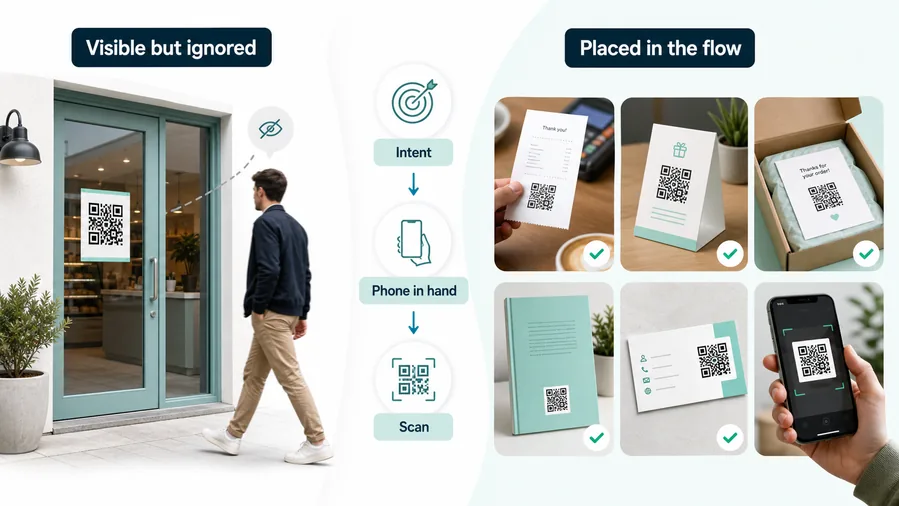
A bare address QR can still leave people lost
A code can open a map but still miss parking, entrance, suite, or pickup instructions.
The printed label should explain which location detail the scan solves.
Put the QR beside the travel decision
Use appointment cards for office directions, event flyers for venue maps, delivery notes for pickup points, and parking signs for lot or entrance details.
The first screen should match that arrival promise.
Where is the scanner going?
Store, office, venue, room, booth, pickup point, parking lot, hotel, clinic, or event entrance.
What detail prevents confusion?
Pin, entrance, suite, floor, gate, hours, parking, transit, accessibility, or contact.
Will location context change?
Use dynamic QR for temporary locations, changing rooms, parking updates, construction, and event logistics.
Is the CTA specific?
Print get directions, find parking, open pickup point, venue map, or office entrance.
Appointment card
Open office, clinic, studio, suite, floor, parking, and arrival instructions.
Invitation or flyer
Show venue address, entrance, parking, transit, accessibility, and event timing.
Storefront sign
Help people find another entrance, pickup point, parking, or local branch page.
Parking sign
Open lot map, walking route, payment page, or building entrance notes.
Delivery note
Use for warehouse, pickup dock, service gate, driver instructions, and contact.
Business card
Send clients to office map, parking, suite, and booking context.
Event handout
Open room map, booth location, shuttle, reception, or after-party directions.
Hotel or travel card
Show local route, venue, pickup, shuttle, and front-desk help.
Address QR placement should prevent the next location question
Use it where directions, parking, or entrance details are more helpful than printing another long line of text.
Directions context
Think about the moment when the person actually needs directions
The best placement is usually close to the decision to travel or navigate. On an event flyer, the address QR should sit near the date, time, parking note, entrance instruction, and venue name. On a real estate sign, it should open the exact listing or map pin while the visitor is standing nearby and deciding whether to book a viewing. On a hotel, campus, clinic, museum, or venue handout, it should help people move to the next physical location without asking staff to repeat directions.
Make the promise beside the code clear. “Open directions,” “Find the entrance,” “Navigate to pickup,” or “Scan for the map” works better than a vague “scan me.” If the location is tricky, use the destination page to explain parking, floor, gate, landmark, accessibility route, or delivery entrance. A QR code can open the map, but the surrounding text should explain which problem the map solves.
For long-running printed materials, dynamic QR codes are safer when the final map link may change. If the office moves, the event entrance changes, the map pin is corrected, or the location page is replaced, you can update the destination without reprinting every card or sign.