QR Code with WhatsApp Logo for Click-to-Chat, Support & Orders
Create QR codes with a WhatsApp logo for click-to-chat links, support, reservations, lead generation, online orders, and customer service. Ready for print and digital use.
Free QR code generator
Create a QR code online
Generate QR codes for websites, email, phone numbers, vCards, Wi-Fi, plain text, forms, PDF files, and campaign links. Customize colors, add a logo or frame, then download a print-ready PNG or SVG.
Choose QR code type
Website QR code, Email QR code, Phone QR code, vCard QR code, Wi-Fi QR code, Text QR code, SMS, WhatsApp, event, and download links.
Add your content
Enter your website URL, contact details, message, phone number, location, or file destination before generating the QR code.
Customize and download
Adjust QR colors, error correction, logo, frame, size, and margin. Generate QR Code, Download PNG, Download SVG, or Save and track scans.
Click-to-chat handoff
Use a WhatsApp logo QR code when the useful next step is a real chat, reservation, support, order, or sales conversation
A QR code with the WhatsApp logo is a branded QR code that opens a real WhatsApp link, usually a wa.me click-to-chat URL or a WhatsApp destination with a prefilled message. It is not a WhatsApp API integration and it does not automate inboxes, send messages, manage templates, or replace business account setup. The logo helps scanners understand that the code starts a chat, not a mystery web page.
This is useful for restaurants, local services, ecommerce stores, salons, clinics, real estate agents, sales teams, support desks, rental businesses, and delivery workflows. A table card can start a reservation request. A product label can open support. A packaging insert can start a reorder conversation. A real estate flyer can open a viewing request. A salon sticker can help clients ask for appointment times without typing a number.
The strongest WhatsApp QR codes reduce friction at the exact moment someone wants help, pricing, booking, ordering, or confirmation. Use a direct chat link when the conversation is simple. Use a prefilled message when you need context, such as the product name, table number, appointment type, quote request, or order question. QR Code Lab creates the code, design, and tracking; WhatsApp controls the chat app, account behavior, delivery, and privacy.
WhatsApp chat QR workflow
Use a WhatsApp logo QR when the scan should start a real conversation
Chat QRA WhatsApp QR code is useful when printed material should move people into a chat for support, booking, sales questions, quotes, delivery, service updates, or local business follow-up.
Turn printed interest into a direct message
Menus, service flyers, product packaging, appointment cards, storefront signs, receipts, and event handouts can all create questions. A WhatsApp logo QR removes typing and opens the chat path while the customer still remembers what they need.
Use the printed CTA to set the topic: message for booking, ask about delivery, get support, request a quote, or reorder.
Set the conversation boundary before the scan
WhatsApp feels personal, so the printed material should explain what kind of message is appropriate. A support card, booking flyer, menu, and sales sheet each needs a different promise and sometimes a prefilled message to keep the conversation focused.
Good QR copy reduces vague messages and helps the team answer faster.
Keep public chat routes manageable after printing
Phone numbers, team ownership, business hours, support flows, and campaign offers can change. A dynamic QR lets the same WhatsApp-branded print keep working while the destination moves to a new chat, landing page, or routing path.
Use dynamic QR for public signs, packaging, menus, and long-lived printed service material.A WhatsApp QR should make the conversation feel expected and useful
The scan opens a human communication channel, so the printed context must be honest about what will happen next: who receives the message, what the scanner can ask, and when a reply is realistic.
Match the QR to one clear chat job instead of inviting every possible question at once.Support question
Use after purchase, installation, onboarding, or service delivery when the customer may need help.
Booking or quote
Use on service flyers, appointment cards, local ads, and storefront material where the next step is inquiry.
Order or delivery
Use for menus, retail, local commerce, pickup, delivery, and reorder prompts.
Managed chat path
Use dynamic QR when the public chat destination, phone number, or routing process may change later.
WhatsApp placement
Place the WhatsApp QR where a message is the natural next step
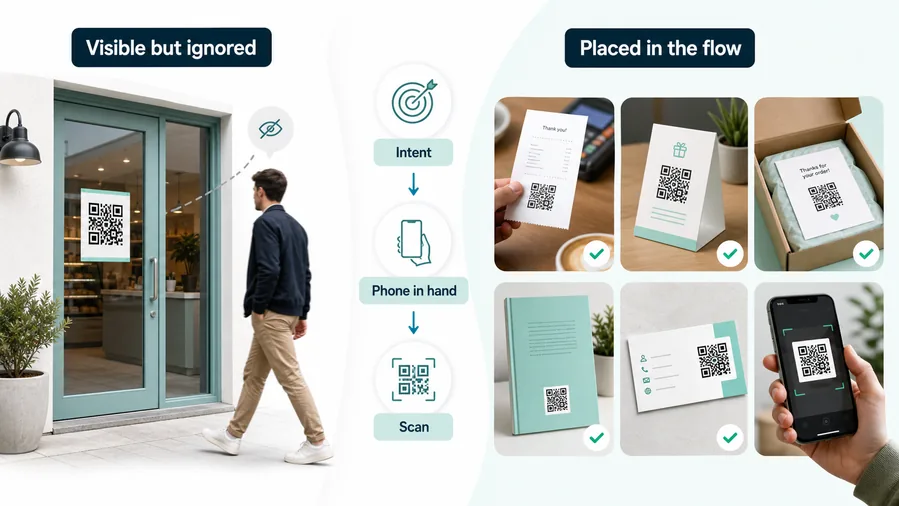
PlacementWhatsApp scans work best at customer moments that already create a question, booking need, service request, delivery decision, support issue, or local follow-up.
A WhatsApp logo alone can feel too open-ended
People may hesitate if they do not know whether the chat is for sales, support, booking, delivery, complaints, or general contact.
A public chat QR should set expectation so the first message is useful and the team can respond properly.
Put the QR beside the reason to message
Place it near the service offer, booking prompt, support instruction, menu item, delivery note, warranty card, or local contact promise it completes.
When the printed context defines the conversation, the scan feels helpful rather than intrusive.
What should the customer ask?
Choose booking, quote, support, delivery, order, return, availability, product help, or local contact.
Who receives the message?
Make sure the destination matches the business account, support team, location, or service owner named in print.
Is the timing reasonable?
Use WhatsApp where people can send a message now and understand when a reply is likely.
Could the number change later?
Use dynamic QR when a printed chat route may need a new number, team, bot, or landing page.
Service flyer
Use for quote requests, booking questions, consultations, availability, and local lead capture.
Menu or table card
Open ordering, delivery questions, reservations, catering inquiries, or customer feedback while guests are deciding.
Product packaging
Send buyers to setup help, warranty questions, care support, replacement parts, or post-purchase service.
Receipt or checkout card
Useful for support, returns, delivery follow-up, reviews, reorder questions, and loyalty conversations.
Storefront sign
Let visitors message for hours, appointment availability, stock questions, directions, or quick service inquiries.
Appointment card
Use for rescheduling, reminders, booking follow-up, preparation questions, or aftercare support.
Event handout
Open organizer contact, attendee help, vendor questions, pickup instructions, or local coordination.
Business card
Give prospects a direct chat route after a meeting, quote discussion, or local service conversation.
Use the QR where a chat solves the next problem
A WhatsApp QR works when the printed material makes the message topic, owner, and expected response clear.
WhatsApp scan experience
Make the WhatsApp chat path specific enough to be useful
Scan UXThe QR should open a chat that matches the printed promise and gives the scanner confidence about what to send. A prefilled message or clear nearby CTA can make the first conversation much cleaner.
Direct action: the device handles it
Wi-Fi, vCard, phone, email, SMS, plain URLWhen the QR code contains direct data, the phone decides what to show. It may open the native Wi-Fi join prompt, contact-save screen, email client, phone dialer, SMS composer, browser, or another app chosen by the user.
There is not much QR Code Lab can improve inside that native interface. Compatibility depends on the scanner app, camera, operating system, browser, and user settings. Your responsibility is to encode clean data: correct Wi-Fi credentials, a valid email, a tidy vCard, a working URL, and a clear printed caption near the code.
Tracked QR: your destination carries the experience
Dynamic URL, tracked campaign, external page, PDF, formWhen a dynamic QR code redirects to your website, form, shop page, PDF, booking page, or campaign, QR Code Lab can manage the link, keep it editable, and record scan analytics. But the page people land on is still your experience.
That destination should be fast, mobile-friendly, and honest about the promise printed near the QR code. The main CTA should be visible without hunting, forms should be short, files should open cleanly on phones, and the content should not feel like a desktop page squeezed onto a small screen.
Microlanding: QR Code Lab shapes the experience
Hosted page, buttons, image, files, contact, feedbackA QR Code Lab microlanding page is useful when you do not have a good mobile destination or when one scan should offer several actions. Instead of sending people to a heavy page, you can present a clean mobile-first page with clear buttons, files, images, links, and contact actions.
This is where QR Code Lab can do the most for scan experience. The content is organized for phones, buttons are easy to tap, PDF or ZIP downloads can be presented clearly, and the page can be updated after printing. It works well for books, packaging, menus, events, instructions, bonus materials, and feedback flows.
Does the QR open the intended chat?
Test the WhatsApp link on mobile and confirm the account, number, and optional prefilled message.
Is the chat purpose clear before scanning?
Tell people whether they should book, ask for support, request a quote, order, or contact a location.
Is there a fallback if chat changes?
Use dynamic QR for long-lived printed material so the route can move without reprinting.
The scan should start the right conversation
A WhatsApp QR is strongest when it turns a real customer question into a clear, trusted chat path.
Service and support flow
Place WhatsApp QR codes where customers would otherwise wait, search, type a phone number, or ask staff to repeat details
Useful placements include menus, receipts, stickers, packaging, appointment cards, delivery bags, product inserts, clinic handouts, real estate flyers, service vans, window signs, table tents, invoices, and after-service cards. The CTA should be concrete: message us on WhatsApp, ask about this product, book a visit, request a quote, reorder by chat, reserve a table, or contact support. A vague scan me label is weaker than telling the customer exactly what the chat is for.
For static WhatsApp links, the printed QR code can be very direct, but the destination is fixed. If the phone number, prefilled message, campaign, or routing policy changes, you may need to reprint. A dynamic QR code gives you more control: update the WhatsApp link later, switch from sales to support, route an old flyer to a new number, or temporarily point a printed code to a service notice or microlanding page.
Tracking helps you understand whether a sticker, receipt, package insert, or local flyer is actually driving chat intent. QR Code Lab can count scans and show scan timing, device, and rough location signals, while WhatsApp remains the place where the conversation happens. Keep the logo readable but scan-safe, with clear contrast and enough quiet zone around the QR pattern.