QR Code API for Apps, Automation & Dynamic Workflows
Generate QR codes from your own app with API keys, usage limits, file responses, saved codes, dynamic options, and tracking support for product or print automation at scale.
Free QR code generator
Create a QR code online
Generate QR codes for websites, email, phone numbers, vCards, Wi-Fi, plain text, forms, PDF files, and campaign links. Customize colors, add a logo or frame, then download a print-ready PNG or SVG.
Choose QR code type
Website QR code, Email QR code, Phone QR code, vCard QR code, Wi-Fi QR code, Text QR code, SMS, WhatsApp, event, and download links.
Add your content
Enter your website URL, contact details, message, phone number, location, or file destination before generating the QR code.
Customize and download
Adjust QR colors, error correction, logo, frame, size, and margin. Generate QR Code, Download PNG, Download SVG, or Save and track scans.
API documentation
Generate QR codes from your app with one authenticated request
Use the QR Code Lab API when your product, CRM, ecommerce flow, internal tool, or print workflow needs to create QR codes automatically instead of asking a person to copy settings into the dashboard.
POST /api/qr/api/generatex-api-key header or apiKey query parameter.response: "file" to receive PNG, JPG, SVG, or PDF bytes.Request body
| Parameter | Type | Required | Allowed values | Description |
|---|---|---|---|---|
data | string | Yes | URL, text, email, phone, vCard, Wi-Fi string | Main QR content. Use this field for new integrations. |
text | string | No | Any text payload | Alternative QR content field when data is not provided. |
title | string | No | Short title | Name for saved QR codes and generated filenames. |
type | string | No | url, text, email, phone, vcard, wifi, api, custom | Semantic QR type stored with saved records. |
save | boolean | No | true, false | When true, saves a trackable QR code with analytics. |
response | string | No | json, file | Choose JSON metadata or direct binary output. |
download | boolean | No | true, false | For file responses, controls attachment versus inline delivery. |
size | number | No | 400-1000 | Output width and height in pixels. |
file | string | No | png, jpg, jpeg, svg, pdf | Output format. JPEG is normalized to JPG. |
Design config and QR options
config.bodyQR module style: square, dots, rounded, mosaic, classy, plus, cross, star, heart, dash, vertical.config.eyeFinder frame style: square, rounded, circle, dotted, none, and frame variants.config.eyeBallInner finder style: square, circle, rounded, diamond, star, or heart.config.bodyColorForeground hex color for the main QR modules.config.bgColorBackground color. Keep it light for reliable scanning.config.logoPreset logo path or image data URL.options.errorCorrectionLevelL, M, Q, or H. Use H when placing a logo in the center.options.marginQuiet zone around the QR, measured in modules.API keys, request limits, saved QR limits, and paid usage behavior depend on your current account plan and available balance.
Integration check: request an image without creating a saved QR
The existing examples below cover file and JSON responses. Start an integration with an explicit save decision so a retry does not accidentally create another saved object.
POST /api/qr/api/generate
x-api-key: YOUR_API_KEY
Content-Type: application/json

{"data":"https://example.com","save":false,"response":"json","file":"png","size":800}- Without saving
- save:false requests an image without creating a dashboard QR record. It is still an authenticated API request and is subject to applicable request limits.
- With saving
- save:true uses the saved-code workflow and its limits. Do not assume repeated requests are idempotent.
- Failure handling
- Check the HTTP status before parsing or storing a result. Missing or invalid keys, limits and validation failures are not successful QR responses.
The key shown is a placeholder. Keep real API keys on your server, not in browser code or a public example.
API examples
Copy-ready examples for common QR Code API responses
Start with JSON while integrating, then switch to a file response when your workflow needs a downloadable QR image or PDF.
cURL: JSON response with base64 QR
curl -X POST https://qr-code-lab.com/api/qr/api/generate \
  -H "Content-Type: application/json" \
  -H "x-api-key: YOUR_API_KEY" \
  -d '{
    "data": "https://example.com",
    "save": false,
    "response": "json",
    "size": 800,
    "file": "png",
    "config": {
      "body": "dots",
      "eye": "frame-rounded",
      "eyeBall": "ball-circle",
      "bodyColor": "#111111",
      "bgColor": "#ffffff"
    }
  }'
cURL: binary PNG download
curl -X POST https://qr-code-lab.com/api/qr/api/generate \
  -H "Content-Type: application/json" \
  -H "x-api-key: YOUR_API_KEY" \
  --output qr-code.png \
  -d '{
    "data": "https://example.com",
    "save": true,
    "response": "file",
    "download": true,
    "size": 1000,
    "file": "png"
  }'
Node.js fetch
const response = await fetch("https://qr-code-lab.com/api/qr/api/generate", {
  method: "POST",
  headers: {
    "Content-Type": "application/json",
    "x-api-key": "YOUR_API_KEY"
  },
  body: JSON.stringify({
    data: "https://example.com",
    save: true,
    response: "json",
    size: 800,
    file: "png",
    config: {
      body: "rounded",
      bodyColor: "#111111",
      bgColor: "#ffffff",
      logoSize: 0.2
    }
  })
});

const result = await response.json();
console.log(result.qr || result.dataUrl);
Python requests
import requests

response = requests.post(
    "https://qr-code-lab.com/api/qr/api/generate",
    headers={
        "Content-Type": "application/json",
        "x-api-key": "YOUR_API_KEY",
    },
    json={
        "data": "https://example.com",
        "save": True,
        "response": "json",
        "size": 800,
        "file": "png",
        "config": {
            "body": "dots",
            "bodyColor": "#111111",
            "bgColor": "#ffffff",
        },
    },
)

print(response.json())
API workflow choice
Choose the QR API setup by what your app has to create and control
API setupA QR Code API workflow is useful when codes must be generated from products, users, campaigns, tickets, labels, documents, or internal systems instead of one at a time in a browser.
URL QR code
Use for websites, landing pages, menus, product pages, portfolios, booking pages, and campaign pages.
Best dynamic when links may changePDF / File QR code
Use for menus, manuals, worksheets, bonus materials, brochures, certificates, ZIP archives, and checklists.
Dynamic is safer for printvCard QR code
Use for business cards, badges, counters, portfolios, sales materials, and follow-up contact details.
Static opens native contact saveWi-Fi QR code
Use for cafes, hotels, offices, classrooms, venues, rental spaces, and guest networks.
Usually best as staticForm QR code
Use for feedback, registrations, quote requests, surveys, support requests, applications, and check-in.
Dynamic helps forms evolveWhatsApp / messaging QR
Use when the next step is a conversation: support, sales, booking, delivery questions, or consultation.
Prefilled messages reduce frictionMaps QR code
Use for venues, offices, stores, events, pickup points, property listings, booths, and meeting locations.
Great for physical destinationsSocial QR code
Use for Instagram, TikTok, YouTube, X, LinkedIn, Behance, creator pages, and community profiles.
Best when relationship continuesPayment link QR code
Use for invoices, tips, donations, event payments, deposits, checkout pages, and payment requests.
Make amount and context clearNative action?
Wi-Fi, vCard, email, phone, and SMS often work best when the action is encoded directly, especially if the native phone interface matters.
Editable or measurable?
Use a dynamic QR code when the destination may change, files may be replaced, campaigns need analytics, or printed material must stay useful later.
Several actions?
Use a microlanding page when one scan should offer buttons, files, contact, feedback, booking, social links, or multiple next steps.
API design starts with naming and ownership
A clean QR API workflow should define who owns destinations, how codes are named, which formats are exported, and how failed rows are handled.
After-print control
Use dynamic QR in API workflows when generated codes need life after export
DynamicAutomated QR creation often feeds print, packaging, tickets, campaigns, classrooms, or product systems. Dynamic routing protects those generated codes when destinations change later.
A generated static code is still locked after export
The API can create thousands of static QR images quickly, but each image still contains a final payload.
If a product page, PDF, support URL, or campaign destination moves, the exported code cannot be fixed from the API later.
Managed links keep generated codes editable and measurable
Dynamic API creation stores a managed destination behind each code, so your system can update the target without regenerating the printed image.
It also gives reporting by code name, campaign, placement, product, branch, batch, or source when those identifiers are passed consistently.
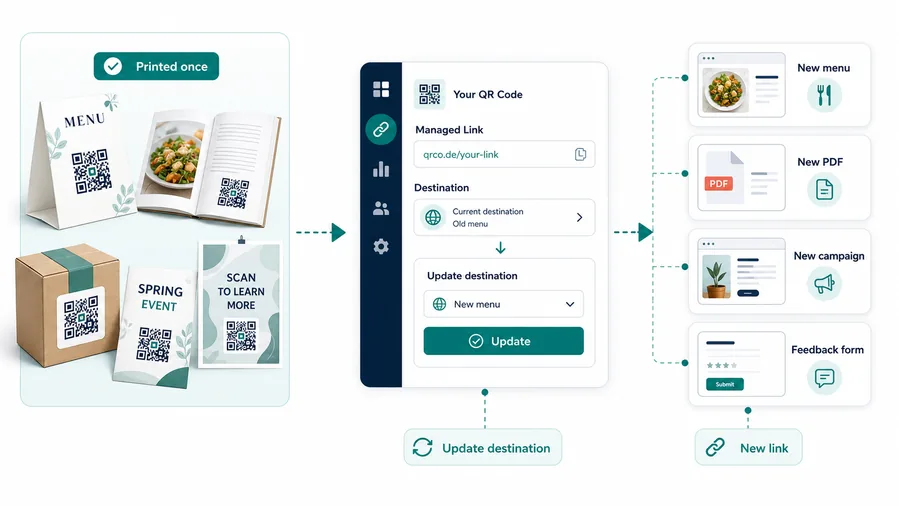
Product and packaging systems
Generate unique codes for SKUs, batches, regions, languages, manuals, warranty, support, and product education.
Campaign automation
Create tracked QR codes for channels, placements, teams, partners, events, mailers, and local ads.
Ticketing and access
Create codes for attendees, rooms, check-in flows, schedules, instructions, or post-event actions.
Internal operations
Automate labels, assets, equipment, training sheets, documents, and service workflows while keeping destinations maintainable.
Use dynamic API output when exported codes need maintenance
If the QR images will be printed, distributed, or embedded at scale, keep destinations editable and code names audit-friendly.
API reporting
Build API-generated QR analytics around names your team can read later
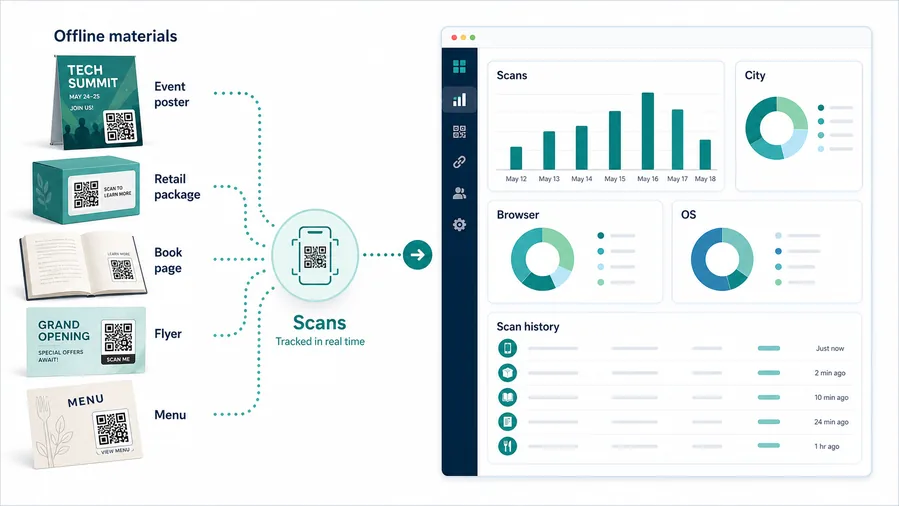
AnalyticsAPI-generated codes are only useful in reports when the request includes clear campaign, product, placement, batch, branch, or source context before the codes go live.
Thousands of generated codes can become one reporting mess
If an API job creates QR codes with generic names, scan history may exist but the team will not know which label, asset, product, or campaign produced it.
Bad naming turns analytics into cleanup work.
Good parameters make reports useful from day one
Pass stable identifiers for product, SKU, campaign, channel, placement, team, location, or batch when the code is created.
Then scan reports can compare real business objects instead of anonymous QR records.
Scan volume
Compare generated codes by product, campaign, placement, batch, or source over the selected period.
Time and device
Review when scans happened and which device, browser, or operating system opened the destination.
Broad location
Use approximate location signals to spot regional patterns without treating them as exact customer identity.
Code comparison
Group codes by the identifiers your API sends so reporting matches the systems that generated them.
Campaign exports
Compare scans across channels, creative versions, regions, teams, and print placements.
Product labels
Review scans by SKU, batch, language, package type, store, or region.
Event operations
Compare attendee materials, booth signs, handouts, badges, rooms, or post-event follow-ups.
Support and documentation
Spot which manuals, labels, assets, or equipment tags drive help-seeking scans.
API analytics depend on creation-time metadata
Decide the naming scheme before generating codes, because reports can only compare the context you captured.
Automation fit
Design the API workflow around the data your system already owns
Start with the object that needs the QR code. For ecommerce, that may be a product, order, package insert, warranty page, reorder link, or setup guide. For SaaS, it may be an onboarding page, support flow, demo workspace, or customer resource. For agencies, it may be a repeatable campaign asset with the same brand rules and output format every time.
The API works best when the source system sends clean data. Store the destination, code name, owner, campaign, placement, output format, and any notes that will help someone understand the code later. A QR image alone is not enough context after the file has been printed, emailed, embedded in packaging, or handed to a designer.
Before producing API-generated codes at scale, keep a review step. Test a small sample, open the destinations on mobile, confirm the exported files match the print need, and use dynamic QR codes when the destination may change. Automation should reduce manual work without making mistakes harder to notice. A few checked examples can protect a much larger batch.