Wedding RSVP QR Code Generator for Online Guest Replies

Create a wedding RSVP QR code for invitations, save-the-dates, wedding websites, meal choices, plus-ones, song requests, guest notes, response forms, and printed RSVP cards.

Wedding reply path

Make wedding RSVPs easy to answer from the invitation

A wedding RSVP QR code sends guests to the exact reply form, wedding website RSVP page, meal choice form, plus-one question, attendance count, or reminder page without asking anyone to type a long URL from a printed card. It is useful for invitations, save-the-dates, details cards, wedding websites, table cards, planner packets, and reminder messages.

The purpose is narrower than a general wedding website QR code. This page is about collecting guest replies: who is attending, how many guests are included, meal choices, song requests, accommodation notes, accessibility needs, and any details the couple or planner needs before the deadline. The QR code should lead guests straight to that RSVP action, not make them hunt through a full site.

QR Code Lab creates the QR code, dynamic destination, and scan analytics. It does not collect RSVPs, manage guest lists, send reminders, process registry gifts, or run wedding websites. Your form tool, wedding website, planner system, spreadsheet, or RSVP platform handles the actual replies and private guest information.

How QR codes help

How QR codes help wedding RSVP flows with wedding websites, save-the-dates, table cards, and date

Attendee flow

Use QR codes to move wedding RSVP flows from invitations, banners, badges, programs, table cards, venue signs, and attendee handouts to wedding websites, save-the-dates, table cards, and date without making guests search or type a long URL.

Event registration desk with badge pickup and attendee check-in context.

Turn promotion and entry moments into the right event step

Place QR codes on invitations, posters, event banners, booth signs, badges, programs, or registration desks so wedding RSVP flows can send people to wedding websites, RSVP pages, ticket pages, attendee details, check-in pages, schedules, or venue maps.

QR Code Lab links people to the right event destination; keep ticket validation, attendee records, and entry systems in the event platform you already use.
Event venue and trade show floor with attendee checking schedule details.

Keep schedules, maps, speakers, and venue details easy to reach

Use QR codes for conferences, seminars, webinars, workshops, trade shows, meetups, concerts, festivals, sports events, and venues to open agendas, session pages, speaker bios, event maps, sponsor pages, replays, updates, or visitor guides.

Dynamic QR codes help when agendas, maps, session links, event pages, or venue details change after signs and handouts are printed.
Wedding invitation and RSVP details on a reception table with smartphones.

Help wedding and party guests find details without extra messages

Point scanners from wedding invitations, save-the-dates, RSVP cards, table cards, party invitations, menus, programs, registry cards, or photo signs to wedding websites, guest response forms, registries, travel details, menus, photo galleries, or guest updates.

A focused printed label works better than a general homepage: RSVP, registry, directions, menu, photos, or schedule.

Match the scan to the exact event moment

For wedding RSVPs, the QR code should point people toward wedding websites, save-the-dates, table cards, and date with a destination that matches the invitation, banner, badge, program, venue sign, table card, or follow-up material they just scanned.

QR Code Lab creates the QR bridge. Ticketing, attendee validation, guest lists, payments, registrations, uploads, replays, maps, and event operations stay with the event, wedding, venue, or form systems you already use.

Name the attendee action

Tell people whether the scan opens registration, RSVP, tickets, a schedule, a map, a wedding website, a gallery, or a follow-up page.

Use the placement as context

Invitations, event banners, badges, programs, booth signs, table cards, and venue signs should each point to a focused next step.

Avoid overpromising entry control

Use QR codes for ticket pages, PDFs, booking pages, or check-in forms unless a separate event system handles unique ticket validation.

Update live event details safely

Use dynamic QR codes when schedules, maps, speaker pages, wedding details, venue guides, or follow-up links may change after printing.

QR Code in 3 Steps

Easy 3 Steps

Follow a simple step-by-step plan to generate a high-quality QR code for any use case.

Step 1
Choose the type
QR code generator - step 1

Select what your QR code should do: website link, email, phone number, text, location, or vCard.

Step 2
Customize the design
QR code generator - step 2

Adjust colors, size, margin, and error correction. Add a logo or frame if needed for branding.

Step 3
Download your QR code
QR code generator - step 3

Generate a preview, test-scan it, then download a print-ready file (PNG/JPEG/WebP) or save it for tracking.

Events, conferences, and weddings

QR Codes for Event Attendees

Attendee flow

Help guests and attendees move through the event without searching emails, asking staff, or typing links: RSVP, check in, open the agenda, find the room, download materials, or send feedback.

Event invitation and registration planning scene.
Before the event

RSVP and registration

A guest scans the invitation, poster, email printout, or wedding card and lands on the right RSVP or registration flow. This is useful when the organizer needs a clear answer fast: who is coming, who needs a seat, meal choice, workshop slot, plus-one, or special access.

Conference attendees and check-in context.
At the entrance

Tickets and check-in

At the entrance, the attendee wants to get in, not search old emails. A QR on a badge, ticket, confirmation page, or entrance sign can open the ticket wallet, check-in page, attendee profile, or fast registration desk instructions.

Conference session and event agenda context.
During the event

Agenda and live updates

A printed program often ages during the event. A dynamic QR can send attendees to the current agenda, session list, schedule changes, speaker updates, room changes, or wedding timeline without reprinting handouts.

Venue and event space representing maps and directions.
Find the place

Venue map and directions

People do not want to ask where room B, parking, cloakroom, coffee, restrooms, photo zone, stage, or breakout area is. Place QR codes where the question appears: lobby, elevator, registration desk, room signs, badges, and venue boards.

Speaker presentation scene representing event materials and feedback.
After a session

Speaker materials and feedback

After a session, attendees can scan a slide, poster, handout, or table sign to open slides, PDFs, worksheets, links, speaker profile, Q&A, or feedback form. The attendee gets the materials; the organizer gets a clean follow-up action.

For attendees, a QR code is a shortcut, not a feature

The scan should solve the small problem happening right now. A person may need the ticket at the door, the agenda in the lobby, a room map outside the elevator, slides after a talk, or feedback after the event. The best event QR codes appear at the moment of need and open a mobile page with one obvious first action.

For organizers, printed materials become easier to manage

Event print changes quickly: room names, speaker order, session times, materials, sponsor offers, maps, feedback forms, RSVP status, and post-event links. Dynamic QR codes let badges, programs, invitations, table signs, and posters stay printed while the destination or content can change behind the code.

Match the QR code to the attendee moment

Invitation or email printout: RSVP and registration.Entrance, ticket, or badge: check-in and attendee profile.Lobby or registration desk: agenda and map.Room sign: session details or speaker materials.Final slide or thank-you card: feedback and follow-up.

Print-ready QR workflows

QR Code Print Checklist

Print ready

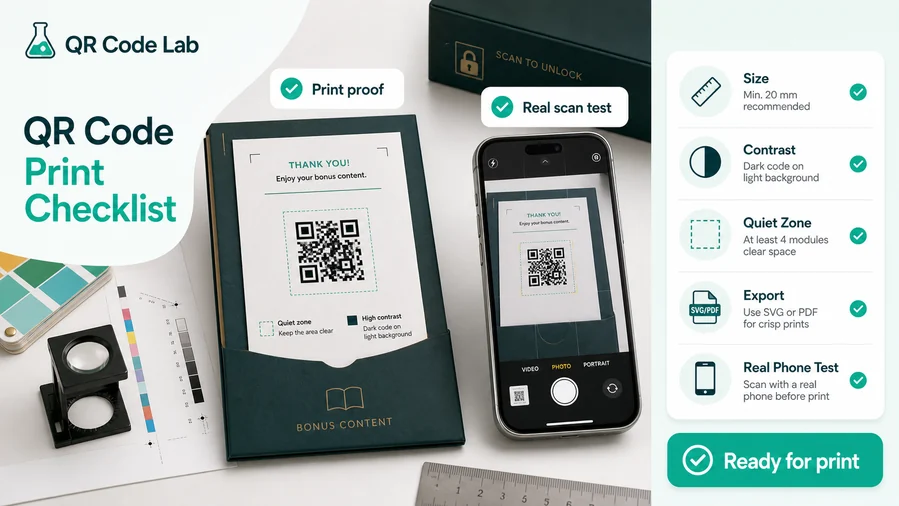
A printed QR code has to survive ink, paper, lighting, camera distance, and real people in a hurry. The safest workflow is to prepare the code, the scan destination, and the mobile landing experience before the file goes to print.

Printed QR codes on books, packaging, and flyers connecting to a QR Code Lab microlanding page with image upload, buttons, PDF, ZIP, and feedback actions.

Make the printed code easy to scan

Start with the physical basics: give the QR code enough size for the viewing distance, keep a clean quiet zone around it, and use strong contrast between the code and the background. A decorative frame or brand color is fine only while the finder squares and the pattern remain clear.

Export SVG or PDF when the QR code goes into professional print layouts. Raster files can work for small jobs, but vector output protects sharp edges on packaging, books, posters, labels, inserts, and manuals. Avoid inverted colors unless you test them on several phones, because some combinations look stylish on screen and scan poorly on paper.

Test the scan like a reader or customer will

Do not test only the design file on your monitor. Print a sample at the real size, scan it with a phone from the likely distance, and check it under normal lighting. A QR code in a book margin, on glossy packaging, on a folded flyer, or behind a display window behaves differently from the same code on a bright screen.

When the printed material is expensive to replace, use a dynamic QR code. If the destination changes later, the printed code can keep working while the link, file, offer, feedback form, or microlanding page is updated in QR Code Lab.

Microlanding pages

Use a microlanding page when the scan needs more than one action

A direct URL is enough when every scanner should go to the same single page. For books, manuals, packaging, training material, event handouts, and product inserts, a microlanding page is often more useful because it can collect several clear actions behind one printed QR code.

In QR Code Lab you can make that page practical: upload a cover image or product image, add buttons for the main action, attach a PDF for reading, add a ZIP with bonus files, and include a feedback or contact path. The printed QR code stays simple, while the destination can present the exact next step the scanner needs.

Book bonus page

A QR code inside a book can open a mobile page with a cover image, downloadable PDF worksheets, a ZIP archive with templates or source files, and a feedback button for reader questions or reviews.

Manual or course materials

A printed lesson, workbook, or manual can link to updated examples, correction notes, extra exercises, downloadable files, and a support form without making the printed page crowded.

Packaging insert

A package card can lead to setup instructions, warranty registration, product care PDFs, recipe files, safety notes, or a review request, all arranged as clear mobile buttons.

Flyer or event handout

A flyer can open registration, schedule downloads, maps, speaker files, coupon PDFs, or a follow-up form, and the destination can be changed after the material is already distributed.

Print the code only after the scan path is ready

The QR image, the printed layout, and the destination should be tested together. When the scan opens a useful microlanding page with the right buttons, files, image, and fallback actions, the printed material feels intentional instead of like a shortcut pasted onto the page.

Placement as timing

Where to Place This QR Code

Scan moment

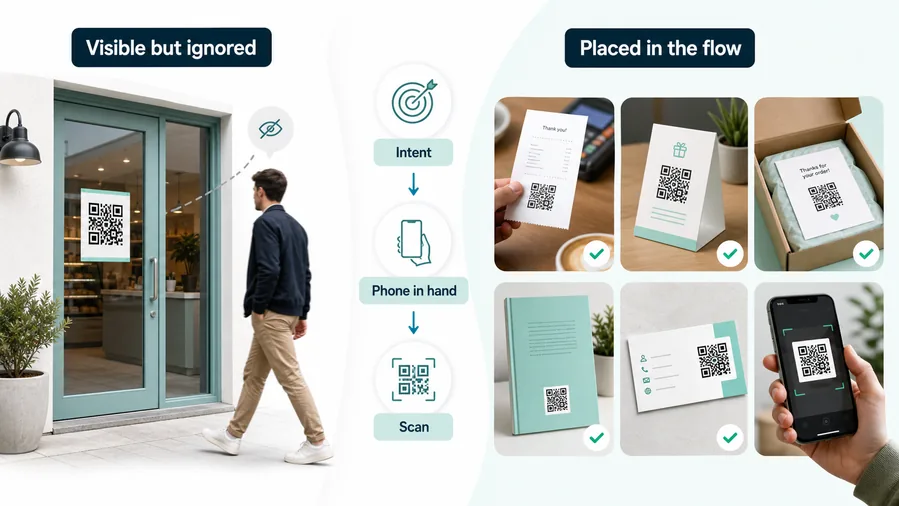
Everyone knows a QR code can go on a cover, poster, label, receipt, table tent, window sign, or business card. The better question is where the person will actually have a reason, a pause, and a phone in hand.

QR code placement comparison: visible but ignored on a storefront door versus placed in the user flow on receipts, table tents, package inserts, books, business cards, and phone-ready moments.
Obvious placement

Visible does not always mean scannable

A QR code on the entrance door, the far corner of a poster, or the front of a package may look like the obvious place. It is visible, it fits the layout, and everyone can point to it in the design file.

But visibility is not the same as scan intent. If the person is walking, carrying bags, entering a store, or still deciding whether they care, the phone is often in a pocket or bag. The code is technically present, but the moment is weak.

Flow-aware placement

Place the code where the next action already makes sense

Better placement starts from the product flow. What did the person just do? What are they likely to want next? Are they stopped, waiting, holding the product, reading the page, opening the package, or checking out?

That is usually where the QR code belongs: after the purchase on a receipt, on a table while the guest is seated, inside the book where bonus material is relevant, on a package insert during unboxing, or on a business card after a conversation.

What just happened?

A scan is more likely after a meaningful action: payment, unboxing, reading a chapter, receiving a card, sitting at a table, or waiting at an event.

What should happen next?

The placement should match the next useful step: save a contact, open a menu, download files, leave feedback, register, reorder, review, or learn more.

Is the phone naturally available?

A code near checkout, on a receipt, beside a table, or inside a manual often performs better than a code people pass while their phone is still away.

Is the value obvious in two seconds?

The scan prompt should say what the person gets: bonus PDF, setup guide, warranty, menu, coupon, feedback, contact save, booking, or updated resources.

Receipt or after checkout

Strong for reviews, loyalty signup, warranty registration, reorder links, feedback, and support because the purchase just happened and the phone is often nearby.

Table tent or menu

Works when the person is seated, waiting, choosing, or ready to order. The scan has time and context instead of fighting a moving doorway moment.

Book page or back cover

Use the page where the bonus makes sense: after a chapter, near an exercise, on the back page for reader resources, downloads, updates, or feedback.

Package insert or label

Place it where unboxing creates a question: setup, care, warranty, recipe, product education, safety notes, replacement parts, or downloadable files.

Poster or event sign

Best where people pause: registration line, booth, waiting area, seat back, schedule board, or exit path. Weak when people only pass at speed.

Business card

Useful after a conversation because the person already knows why they might save a contact, open a portfolio, book a call, or follow up.

Window sign

Good for after-hours menus, booking, pickup instructions, or quick offers. Avoid complex actions when the person is outside and just walking by.

Cover or front label

Use it only when the promise is immediate and clear. Otherwise the better scan moment is often inside the material or after the first interaction.

Place the QR code at the moment of intent

The art is not putting the code where there is empty space. The art is catching the moment when the person understands the value, has the phone ready, and can act without breaking their flow.

Print-safe dynamic QR codes

Change the Destination After Printing

Dynamic safety

A printed QR code is easy to scan, but painful to correct. QR Code Lab keeps the physical code in place while letting you update where it sends people.

Static QR disappointment

When the link changes, the printed code does not

A static QR code can be perfectly fine on the day you print it. The problem starts later: the menu URL changes, a PDF is replaced, a campaign page expires, a file moves, or the form you linked to is no longer the right one.

At that point the QR pattern on a book, package, flyer, menu, poster, or label is already fixed. The scan still opens the old destination because the real URL was encoded directly into the code. There is no dashboard switch, no redirect layer, and no practical way to repair the printed material except reprinting it or covering it with a new sticker.

QR Code Lab control

Dynamic QR keeps the same print useful

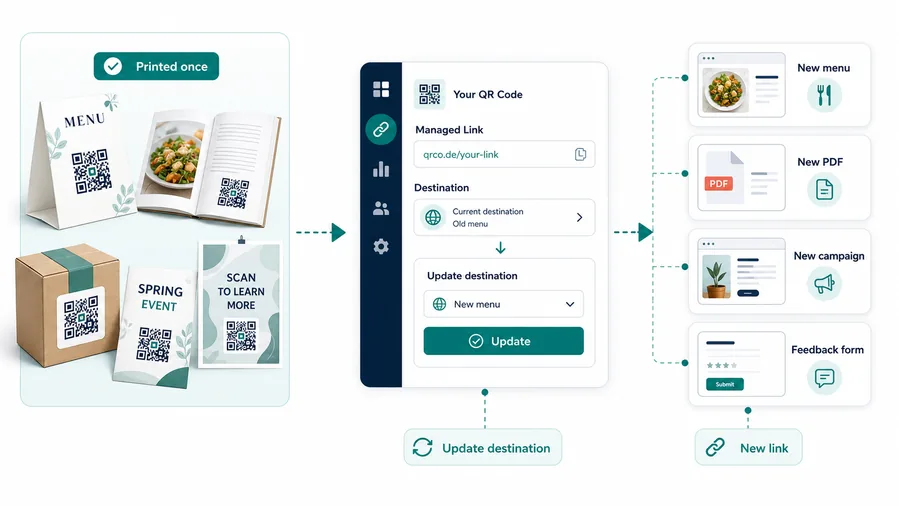
With a dynamic QR code from QR Code Lab, the printed pattern contains a managed link. People scan the same code, but QR Code Lab can send them to the current destination you choose in the dashboard.

That means the physical material can stay in circulation while you replace a URL, upload a newer PDF, move visitors from an old offer to a fresh campaign page, or switch a QR from a menu to a feedback form. You also get scan signals, so the printed asset is not just editable, it becomes measurable.

Printed QR materials keep the same code while QR Code Lab updates the destination to a new menu, PDF, campaign page, or feedback form.

Menus

Keep table tents and takeaway flyers useful when prices, seasonal items, delivery links, or booking pages change.

Books and manuals

Send readers to updated bonus files, errata, support pages, downloads, examples, or feedback forms after the book is already sold.

Packaging

Update warranty pages, instructions, product education, promotions, or batch-specific content without changing every printed label.

Flyers and posters

Move traffic from an expired campaign to the next offer, event page, registration form, or local landing page.

Use dynamic when reprinting would hurt

If the QR code will live on anything physical that costs money or time to replace, use a dynamic QR code. Static is fine for fixed data, but dynamic is the safer choice for printed destinations that may need edits later.

RSVP card and guest flow

Place the RSVP QR where guests can answer before the deadline slips away

Useful placements include invitation RSVP cards, details inserts, save-the-date cards, wedding website cards, welcome notes, rehearsal dinner inserts, planner reminders, table cards, and follow-up messages. CTAs should be specific: RSVP here, reply by Friday, choose your meal, confirm attendance, update guest details, or open the wedding RSVP form.

Dynamic QR codes are helpful because RSVP details can change after stationery is printed. A form can close, a deadline can move, a meal-choice question can be edited, or the destination can switch from RSVP collection to final wedding details after the reply window ends. That keeps printed cards useful instead of frozen around one old form link.

Keep the mobile RSVP experience short and clear. Guests should see the couple names, event date, reply deadline, and the form action quickly. If many people scan but do not submit, the issue may be the linked form: too many fields, slow loading, unclear plus-one wording, or a submit button that is hard to find on mobile.
Offline scan analytics

Track Scans and Learn What Works

Scan analytics

A trackable QR code turns a printed touchpoint into scan events you can review: when people scanned, where the scan appears to come from, and which device, browser, or operating system opened the code.

Offline QR scans from posters, packaging, books, flyers, and menus flowing into QR Code Lab analytics charts and scan history.
Without tracking

Print is hard to improve when you cannot see the scans

A static QR code can open the right page, but after the material is printed you are mostly guessing. You may know that a poster, flyer, package insert, menu, or book page went into the world, but you do not know whether people actually scanned it.

That makes the next decision weaker. It is harder to compare two placements, decide whether a print run deserves repeating, or notice that most people scan from phones while the destination page is awkward on mobile.

QR Code Lab analytics

Each tracked scan becomes a practical signal

With a dynamic QR code from QR Code Lab, the scan passes through a managed link before the visitor reaches the destination. That redirect is what makes analytics possible: the dashboard records the scan event, then sends the visitor onward.

The statistics are useful without pretending to be magic. You can review scan volume over time, city, region, and country signals, device type, OS, browser, and the scan history table. It is enough to understand which printed touchpoints deserve more attention.

Scans over time

Use the recent scan chart to see whether interest appears right after distribution, during an event, after a campaign launch, or long after the printed material is already in circulation.

City and region signals

Location is based on network signals, so it should be treated as directional. It still helps compare markets, venues, local posters, regional packaging, or book audiences.

Device, browser, and OS

See whether scans mostly come from mobile phones and which browsers or operating systems open the code. That matters when the destination contains files, forms, downloads, or a microlanding page.

Scan history

Review individual scan rows with date, IP, device, OS, browser, city, region, and country, so the summary charts are backed by the actual events collected by QR Code Lab.

Marketing campaigns

Compare flyers, posters, and placements by real scan activity before repeating a print run.

Events

See whether badges, venue posters, schedules, or check-in materials actually get scanned during the event.

Retail and packaging

Measure whether labels, shelf talkers, product inserts, and packaging QR codes earn attention after purchase.

Books and printed content

Learn whether readers open bonus pages, downloads, updates, or feedback forms from book pages.

Use tracking when the QR code has a job to prove

Static QR codes can open a destination. Trackable QR codes show whether the printed touchpoint earned scans, from which broad locations, and on which devices. Use them for campaigns, events, retail, packaging, books, and any print asset you may improve or repeat.

Security, checker, and print trust

Keep QR Codes Safe and Trustworthy

Safety notes

Before people scan, make the destination clear. Before you open an unknown QR code, inspect what is inside: decoded content, content type, URL structure, visible risk signals, and the destination report.

Cybersecurity workstation representing fake login and phishing risk.

Fake login pages

A QR code in an unfamiliar place can lead to a phishing page that looks like a bank, email provider, delivery service, social network, or company portal. The page may ask for a login, password, one-time code, recovery phrase, or account verification details and steal them.

Watch for similar-looking domains, long URLs, login or verify keywords, and pages asking for credentials after an unexpected scan.
Security server room representing hidden redirects and unclear destinations.

Hidden redirects and unclear destinations

Short links and redirect chains can hide where a QR code finally sends the scanner. Some redirects are normal analytics, but unknown codes can send people toward malicious pages, fake browser updates, notification scams, suspicious downloads, or install prompts.

A trustworthy QR should not make the final destination mysterious, especially on posters, labels, menus, parking signs, or event materials.
Payment terminal and card context representing payment phishing risk.

Payment pages that look real

Payment QR codes deserve extra caution. A fake page can imitate a bank, checkout, parking payment, donation, ticketing, or payment gateway screen. Button labels and layout can be designed to confuse people about what is being confirmed, cancelled, or paid.

Before paying, check the domain, HTTPS, amount, recipient, and whether the destination matches the place or brand that printed the QR.

Inspect the QR before you trust it

QR Code Lab Safety Checker reads a QR image first and shows what is actually encoded. It can identify URL, Wi-Fi, email, phone, SMS, vCard, or plain text content, then show the decoded value before you decide whether to open it.

The current detailed report is a static URL analysis. It helps reveal the encoded content and basic URL risk signals, but it does not guarantee that a destination is safe and does not replace browser, antivirus, payment, or bank security checks.

Decoded content

See the raw value inside the QR before opening it.

Content type

Recognize URL, Wi-Fi, mailto, phone, SMS, vCard, or plain text.

URL risk signals

Review HTTPS, shorteners, IP addresses, long URLs, encoded characters, query parameters, and sensitive keywords.

Destination report

For URL codes, view final URL fields, static redirect report fields, domain fields, TLS placeholders, page metadata fields, and risk reasons.

Make your own QR codes easier to trust

A safe-looking QR code is not only about security. It is also about reducing uncertainty for the scanner. Use clear destination text, a branded landing page, normal HTTPS domains, and a visible explanation of what happens after scanning.

Write the expected action next to the code.Avoid suspicious short links on public print.Use a branded landing page when possible.Avoid unnecessary redirect layers.For payments, show who receives the money.Test the QR before publishing.Check the decoded content and domain.Protect printed QR placements from sticker replacement.
Built for scanners, brands, and revenue paths

Why people choose QR Code Lab

Advantages

Use one workspace to create branded QR codes, automate generation, check destinations, update dynamic links, and measure what actually gets scanned.

Free to Use

Free to Use

Create, edit, scan QR codes, and view useful statistics in your account without hidden payments.

API Generation With Parameters

API Generation With Parameters

Generate QR codes from the API with practical parameters for destination, size, colors, logo, format, and campaign workflows.

Destination Safety Checker

Destination Safety Checker

Check the final destination before people scan: validate the link, redirects, and basic safety signals before printing or sharing.

Full Design Control

Full Design Control

Customize colors, background, logo, frames, and corner styles while keeping the QR code readable.

Real-Time Analytics

Real-Time Analytics

Track total and unique scans, devices, operating systems, locations, and daily activity in real time.

Advanced Dashboard

Advanced Dashboard

Manage all QR codes in one place: edit content, search, share, organize, and keep campaigns under control.

Dynamic QR Codes

Dynamic QR Codes

Update, pause, or redirect printed QR codes after launch without reprinting the physical asset.

Secure & Reliable

Secure & Reliable

Use a reliable workspace with secure connections, stable redirects, and practical safeguards for QR content.

QR Code Lab workflow

Related QR Code Tools to Try Next

Next steps

Pick the tool that matches what you want the scan to do next: open content, stay editable, look branded, pass a safety check, or fit a real business workflow.